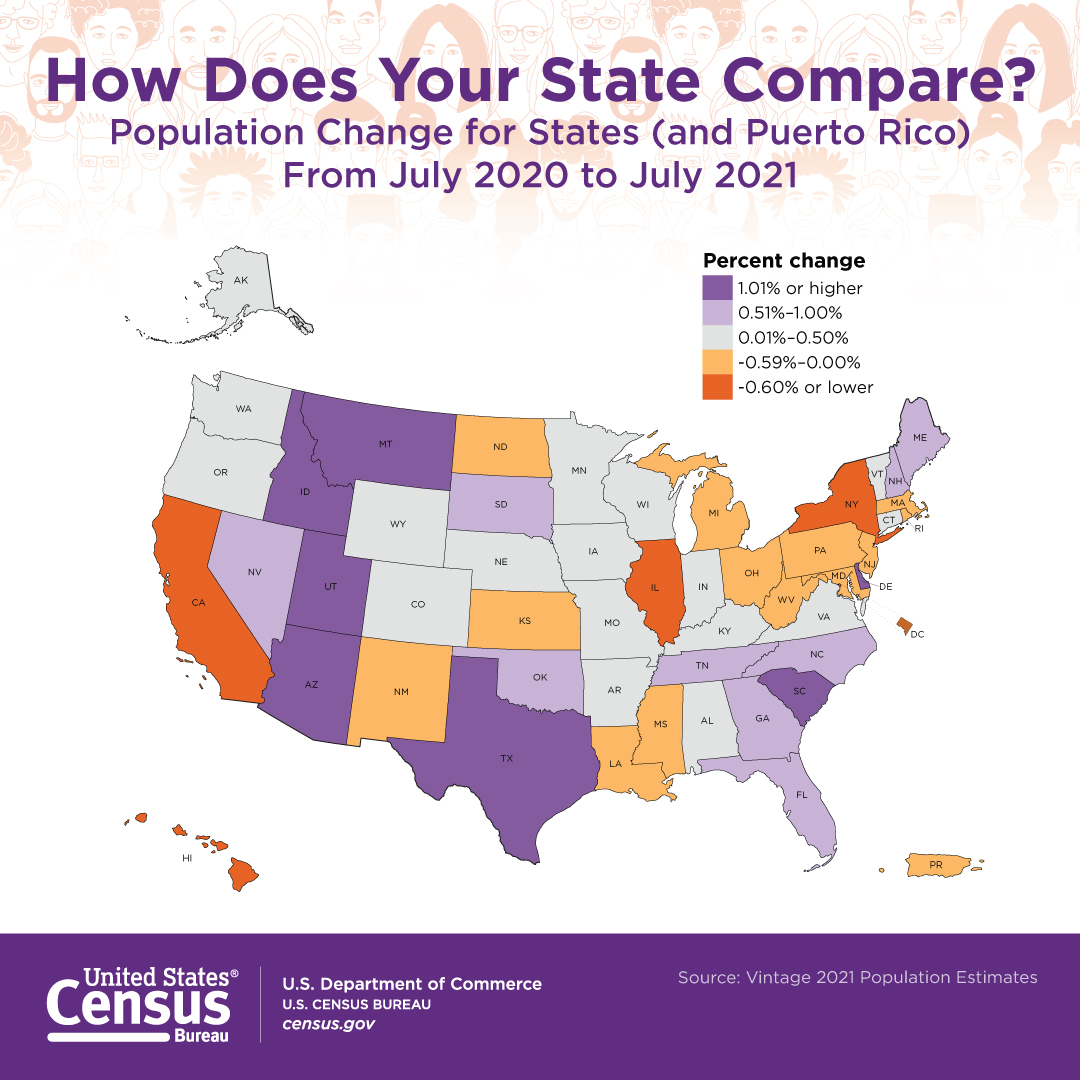
https://www.census.gov/newsroom/press-r ... ates.html
Nebraska:
2020: 1,961,455
2021: 1,963,692
Growth %: 0.11%
Iowa:
2020: 3,188,669
2021: 3,193,079
Growth %: 0.14%





Perhaps the left will wait until the right is ready for it. There is only one way to change minds, make them need it.Stargazer wrote: Tue Dec 28, 2021 5:14 am Maybe it's already been mentioned... but US population growth overall was only at 1/10th a percent each of the past 2 years... so Nebraska is at least matching that. More importantly, Omaha continues to pull in what the state overall loses (whether in state migration or gains from out of state).
With regards to the employment crunch though, I'm actually surprised the left hasn't been pushing the need for opening up immigration more. Is everyone still convinced we're suffering from millennials sitting at home collecting government checks?
It’s a total BS article and WOWT is irresponsible for giving it any air time.. Naturally, many of the narrow-minded on the Omaha Reddit page are taking it up as gospel..ita wrote: Wed Dec 29, 2021 4:59 am https://www.wowt.com/video/2021/12/28/o ... dzi7vWY65w
I couldn't find the referenced list, but if anyone can find it, I would like to see the data.
There’s plenty of reasons people should want to live in Nebraska, and Nebraska’s leaders are now highlighting the state’s strengths and benefits through a new ad campaign entitled, The Good Life Is Calling.
The COVID-19 pandemic has pushed families and businesses to rethink a lot of daily life, including where they want to live and work. Anecdotally, we can find many good examples of people choosing Nebraska as their new home over other states, like this recent piece in the Los Angeles Times.
But it’s also important to look at data to understand if those anecdotes are scaling up and making a measurable impact, or if there are competitive issues Nebraska still needs to address to win over more people.
Recently released U.S. Census Bureau estimates show that while Nebraska’s population increased slightly during the height of the pandemic, the state struggled to stand out among the crowd, while many of our rivals saw a significant influx of new residents.
...
But the impact of these gains was offset by an outmigration of people who previously lived in Nebraska and moved to other states. An estimated net of 3,378 more Nebraskans moved away than people who arrived in Nebraska during this time.
How does this stack up against our immediate neighbors? Colorado leads the pack with a net migration of 21,750, but perhaps surprisingly, Missouri was not far behind, with an impressive increase of 18,604 new residents.
South Dakota was in the middle of the pack with an increase of 6,650. It had similar international migration to Nebraska, but posted a net gain of 5,566 domestic residents.
Like Nebraska, Iowa lost domestic residents, but its international population growth was large enough to put the state in positive territory, with a net of 2,025. Wyoming gained 1,651, almost entirely due to domestic migration, while Kansas lost population at the height of COVID-times, with a net migration decrease of 6,356.
One thing to consider, of those estimated net of 3378 Nebraskans who moved away, is geographically, what part of the state lost most of these estimated Nebraskans..If the majority of that number happen to be from the western 1/3rd of the state, then Nebraska’s loss is likely Colorado’s gain..as I’d say most of that group hightailed it out of NE and to CO..and their migration in number would bear that out..ita wrote: Wed Jan 19, 2022 10:45 pm CENSUS NUMBERS SHOW NEBRASKA’S PANDEMIC POPULATION CHANGE
There’s plenty of reasons people should want to live in Nebraska, and Nebraska’s leaders are now highlighting the state’s strengths and benefits through a new ad campaign entitled, The Good Life Is Calling.
The COVID-19 pandemic has pushed families and businesses to rethink a lot of daily life, including where they want to live and work. Anecdotally, we can find many good examples of people choosing Nebraska as their new home over other states, like this recent piece in the Los Angeles Times.
But it’s also important to look at data to understand if those anecdotes are scaling up and making a measurable impact, or if there are competitive issues Nebraska still needs to address to win over more people.
Recently released U.S. Census Bureau estimates show that while Nebraska’s population increased slightly during the height of the pandemic, the state struggled to stand out among the crowd, while many of our rivals saw a significant influx of new residents.
...
But the impact of these gains was offset by an outmigration of people who previously lived in Nebraska and moved to other states. An estimated net of 3,378 more Nebraskans moved away than people who arrived in Nebraska during this time.
How does this stack up against our immediate neighbors? Colorado leads the pack with a net migration of 21,750, but perhaps surprisingly, Missouri was not far behind, with an impressive increase of 18,604 new residents.
South Dakota was in the middle of the pack with an increase of 6,650. It had similar international migration to Nebraska, but posted a net gain of 5,566 domestic residents.
Like Nebraska, Iowa lost domestic residents, but its international population growth was large enough to put the state in positive territory, with a net of 2,025. Wyoming gained 1,651, almost entirely due to domestic migration, while Kansas lost population at the height of COVID-times, with a net migration decrease of 6,356.
IDK, I lived there for more years than I want to admit... And when people ask me about it I always reply: "It's a terrible place, don't ever go there". It's still better than OKC though I guess...Omaha Cowboy wrote: Fri Jan 21, 2022 7:56 pm Kansas is similar to Nebraska in that the most significant population gains are in the eastern spots of each state within their largest metropolitan area components..
The outlier is Wichita, which, imo, should be doing better relative to its growth rate than it currently is..it is an underrated mid-size 645,000 population metro that has some decent urban bones within its core. Diversification in its economy has really held it back the past 40 years…
Ciao..LiO…Peace
Lol yeah. I’ve never lived there, but have spent a lot of time in Wichita over the years (mostly work related). I suppose if I had to live there, I could make it work. I always tell people that I wouldn’t live in a metropolitan area smaller than Omaha if I had the choice..Athomsfere wrote: Tue Jan 25, 2022 3:59 pmIDK, I lived there for more years than I want to admit... And when people ask me about it I always reply: "It's a terrible place, don't ever go there". It's still better than OKC though I guess...Omaha Cowboy wrote: Fri Jan 21, 2022 7:56 pm Kansas is similar to Nebraska in that the most significant population gains are in the eastern spots of each state within their largest metropolitan area components..
The outlier is Wichita, which, imo, should be doing better relative to its growth rate than it currently is..it is an underrated mid-size 645,000 population metro that has some decent urban bones within its core. Diversification in its economy has really held it back the past 40 years…
Ciao..LiO…Peace
Little Rock would be one IMO.Omaha Cowboy wrote: Tue Jan 25, 2022 6:13 pm
There are worse places to hang a hat than Wichita or Oklahoma City imo…
Ciao..LiO…Peace
At the risk of getting us all off topic: Little Rock I have managed to avoid so far. Nothing but horror stories from anyone I have know that has lived there.guy4omaha wrote: Tue Jan 25, 2022 6:59 pmLittle Rock would be one IMO.Omaha Cowboy wrote: Tue Jan 25, 2022 6:13 pm
There are worse places to hang a hat than Wichita or Oklahoma City imo…
Ciao..LiO…Peace
To tie this all back to Census numbers, Omaha’s growth is pretty significantly outpacing Wichita or Little Rock.. OKC is growing at a higher rate as is NW Arkansas..Athomsfere wrote: Tue Jan 25, 2022 7:30 pmAt the risk of getting us all off topic: Little Rock I have managed to avoid so far. Nothing but horror stories from anyone I have know that has lived there.guy4omaha wrote: Tue Jan 25, 2022 6:59 pmLittle Rock would be one IMO.Omaha Cowboy wrote: Tue Jan 25, 2022 6:13 pm
There are worse places to hang a hat than Wichita or Oklahoma City imo…
Ciao..LiO…Peace
I did live near North West Arkansas though, and it was meh. Great nature, but Fayetteville, Johnson etc. and that whole metro are not a place I'd recommend for more than visits.
I do go to the Ozarks, but not Branson because also terrible, for the kayaking, camping and nature. Great spots if you don't want to go alpine.


For sure it's a nice area to visit. If any one is ever there, I recommend Eureka Springs as a must see too. But yes, the sprawling towns all making up the area make it unlivable for me.Cermak wrote: Wed Jan 26, 2022 4:07 am I was just in NW Arkansas a few months ago. The place is growing like crazy. It’s a different type of metro with no dominant city, about 7 medium to small cities form the metropolitan area of approximately 550k. It’s basically in the Ozarks so it has nice scenery and mild winters. From what I understand it has the best economy in Arkansas. Walmart, JB Hunt and Tyson area all headquartered in the area. Overall I was impressed with it.
Fayetteville the largest city in the metro at 85,000.

Colorado Springs lacks the personality and character that most people associate with Colorado. And like Wichita, it is pretty dependent on one industry, the Air Force, for its economic wellbeing. A fairly boring city, but it is close to some fantastic outdoor options. Pikes Peak and its lakes, Garden of the Gods, Cheyenne Mountain, Fossil beds, etc.TitosBuritoBarn wrote: Fri Jan 28, 2022 3:19 pm I think growth from Denver is fueling most of Colorado Springs's growth, it's attracting people from outside the region that keeps it in check from exploding. I'm not sure CS really lives up to an outsider's expectations of a Colorado lifestyle. Denver, Boulder, and Fort Collins seem more aligned with that whereas CS seems to be more of a Wichita.
 …
 …
Are we talking MSA here? Because Omaha grew at 18.9% vs CS's 15% for 2010 - 2020.Omaha Cowboy wrote: Sat Jan 29, 2022 4:19 am Comparing Austin with Colorado Springs is not an apples to apples comparison..at all..(not that you’re really doing that though)..
Not getting into too much detail as to the why (Austin is a State Capital, diversified economy, huge tech hub, largest university in the state..of which, Colorado Springs has or is none of those things)..Let’s look at growth numbers- from 1980 to 1990, Austin’s metropolitan population grew by 45%. From 1990 to 2000, it grew by 47%. From 2000-2010, 37%. 2010-2020, 33%.. I’ll just go out on a limb and say Colorado Springs will never, EVER experience crazy, unprecedented growth like that. By the way, neither will Omaha..So while you’re right- Omaha and Austin had nearly identical metropolitan populations in 1980, Austin’s growth was, is and remains a RARE anomaly..
Back to the factual numbers- CS will likely motor in growth in that 15-17% per decade mode. Omaha will likely continue it’s 12% decade pace (although with a much more diversified economy and a boom in jobs in medical related fields, it could get in that 13-15% range)..for how long? Who knows.. We need to factor in long range- 40-80 year growth..Tons of things can happen, generationally..but believing CS will boom even remotely close to Austin just isn’t going to happen..and, imo, neither will it boom to a metropolitan population larger than Omaha..
If it happens though, and we’re all still living to see it, I’ll eat a straw hat
Ciao..LiO…Peace
MSA..Athomsfere wrote: Mon Jan 31, 2022 2:29 pmAre we talking MSA here? Because Omaha grew at 18.9% vs CS's 15% for 2010 - 2020.Omaha Cowboy wrote: Sat Jan 29, 2022 4:19 am Comparing Austin with Colorado Springs is not an apples to apples comparison..at all..(not that you’re really doing that though)..
Not getting into too much detail as to the why (Austin is a State Capital, diversified economy, huge tech hub, largest university in the state..of which, Colorado Springs has or is none of those things)..Let’s look at growth numbers- from 1980 to 1990, Austin’s metropolitan population grew by 45%. From 1990 to 2000, it grew by 47%. From 2000-2010, 37%. 2010-2020, 33%.. I’ll just go out on a limb and say Colorado Springs will never, EVER experience crazy, unprecedented growth like that. By the way, neither will Omaha..So while you’re right- Omaha and Austin had nearly identical metropolitan populations in 1980, Austin’s growth was, is and remains a RARE anomaly..
Back to the factual numbers- CS will likely motor in growth in that 15-17% per decade mode. Omaha will likely continue it’s 12% decade pace (although with a much more diversified economy and a boom in jobs in medical related fields, it could get in that 13-15% range)..for how long? Who knows.. We need to factor in long range- 40-80 year growth..Tons of things can happen, generationally..but believing CS will boom even remotely close to Austin just isn’t going to happen..and, imo, neither will it boom to a metropolitan population larger than Omaha..
If it happens though, and we’re all still living to see it, I’ll eat a straw hat
Ciao..LiO…Peace
MSAs were 11.8% and 17%.
Are we accidently mixing our measurements?
Are we talking MSA here? Because Omaha grew at 18.9% vs CS's 15% for 2010 - 2020.