halgy wrote: Wed Mar 27, 2024 7:41 am
Athomsfere wrote: Tue Mar 26, 2024 2:11 pm
Greg S wrote: Tue Mar 26, 2024 1:35 pm
Athomsfere wrote: Tue Mar 26, 2024 12:14 pm
Greg S wrote: Tue Mar 26, 2024 11:33 am
Athomsfere wrote: Mon Mar 25, 2024 8:15 am
S.O.Boy wrote: Sun Mar 24, 2024 3:00 pm
The Rocket Carwash signs are gone and replaced with for lease signs.
Finally some good news for this area.
What's all the bad news that's been happening in that area?
The Library and the Crossroads in a suburban intersection.
If the city wants this to actually act as a usable, walkable and vibrant area: Not adding a carwash is a great move.
I guess I don't really view that area as the suburbs. Even if I did with so much going vertical and infill coming it is transforming away from that. A single car wash would not have really had an impact one way or the other IMO.
I consider it suburban in its development pattern. Its ~8 lanes to cross with parking lots everywhere. That's not how you design a truly vibrant urban area. It instead encourages anyone who wants to shop at Crossroads and check out the library to drive that distance.
And with the newest Crossroads plan of 1200 apartments: that's 30 people / acre: LRT in North America density. Past the point where most of the developed world would have plans for LRT or even medium rail. And it drives me mad that we are squandering this major project so badly.
How would we add LRT into Omaha? Is there way to add it into the existing space, or would we basically have to bulldoze a swath across the city?
I myself had two lines of thought. You technically
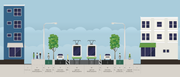
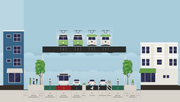
could have light rail in the space Dodge street or 72nd occupy. Some examples of other cities that did it that way are Houston, Minneapolis, Detroit, and Phoenix. It's the ineffective way to do it, as there's always several, and I mean several interactions with vehicle crossings. These have caused numerous accidents and it limits the light rail's ability to move fast, which sorts defeats the purpose. It kind of just makes it a glorified streetcar, and that's not an effective form of mass transit. Plus as Athomsfere illustrated, it would mean giving up 60% of automobile capacity... I'm no expert, but I really don't think that would fly in Omaha.
My other thought was to align light rail in right of way next to the existing freight lines. Plenty of room there for two sets of rails. Just need to convince the freight companies to hand over some of their ROW. There's places that would need to be viaduct(ed), but in the scope of things, that's really not a big deal. Then the rest could be aligned in between, or next to lanes of interstate, freeway, or otherwise expansive roads, like I-80, Kennedy Freeway, West Dodge, Expressway, and Fort Crook Road. You can see my line of thinking here - Omaha Light Rail System Map
https://goo.gl/maps/wdvc24AuP73mNEaS9
The best example of a system utilizing this approach is Denver.
Then you get into actual, true rapid transit. These are actual subways, or elevated heavy rail rapid transit. Best examples here are the DC Metro, Miami-Dade Transit, the Red and Purple lines in LA, and the MARTA in Atlanta. They were all established in the 80's I believe. Think of them as modern subways. They are powered by third rail instead of catenary (overhead) power, and thus they cannot interact with cars or even people at any level, and as a result are faster by that default. They are the most effective form of rail transit, but also by far the most expensive.