OPINION: As Library Demolition Nears,
Old Questions About Public-Private Partnerships Resurface
Omaha’s “Libary Fiasco” ignites new and old debates.
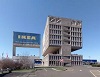
On Aug. 28, the W. Dale Clark library closed its doors for the last time, leaving Omaha without a downtown, “main branch.” Sometime this October pricey demolition work will begin. Soon afterward, Mutual of Omaha’s new skyscraper headquarters will rise, eventually shading the newly renovated Gene Leahy Mall in its verticality.
Although there had been rumblings about closing W. Dale Clark for more than 10 years — when the design for the building itself was completed in 1974 then-library director Frank E. Gibson said the building would only “be good enough for 20 years” — it seems like just yesterday those rumblings became reality.
A year ago, the World-Herald reported W. Dale Clark would likely close and local philanthropic group Heritage Services would be involved in creating a new main library in central Omaha. In the same month, @Save_OPL, the still-anonymous twitter account feeding concerned Omahans inside information about the city’s library business, first posted a thread accusing the city of working with Heritage Services to privatize Omaha’s public library system.
Now, not only is W. Dale Clark closed, but the entire library situation has devolved into what has been colorfully termed the “library fiasco.” First there were the (ongoing) transparency concerns regarding Mutual of Omaha’s deal with the city to acquire the W. Dale Clark site. Then there were the city’s haphazard plans for accommodating the library while plans for the system were in flux. Library administration, kicked out of W. Dale and awaiting an eventual move to the new main library in the 72nd and Dodge area, is for now moving into an abandoned ShopKo building in an obscure south-central part of the city best known for its cemeteries. Meanwhile, the downtown area received a makeshift facility, hastily arranged after the initial 1401 Jones site was determined to have more structural damage than anticipated, pushing that move-in date back to March 2023.
It is maddening, enough to make one lose all hope in our government. Even more concerning, however, is the creation of a public-private advisory committee authorized to make formal recommendations on both the new main central library and the public library system as a whole. This advisory committee, which will consist of library officials, city officials, and representatives affiliated with the Heritage-backed DoSpace, a private technology library in the old Borders on 72nd and Dodge Streets, brings up fears that @Save_OPL’s warnings about privatization may not be far off. For while city and Heritage officials have vehemently denied the library is being privatized – Mayor Stothert, for her part, insisted on Sept. 22, 2021, that “Heritage has no – no – plan whatsoever to even push for privatization of our libraries” – it is difficult for me to see this new committee as anything other than a first step toward anything else.
Because this advisory committee looks an awful lot like the library-version of the Metropolitan Entertainment and Convention Authority, aka MECA, the semi-independent, unelected board that manages the downtown arena, baseball stadium, and the three parks (including the Gene Leahy Mall) that make up the “RiverFront” development.
MECA has its origins in the Metropolitan Omaha Convention/Sports and Entertainment Authority, an 11-member private citizens group created in 1997 with support from both the city of Omaha and the Greater Omaha Chamber of Commerce to discuss the best path forward on a potential convention center/arena. Nicknamed the “Sokol Commission” after its president, David Sokol, then-chief executive of CalEnergy Inc., and consisting primarily of influential, white businesspersons, the commission put forth a plan for a $275 million center that would be partly financed through private funds and managed by an unelected, semi-autonomous board of governors.
In 1999, the World-Herald described Sokol’s viewpoint, writing “the switch to a privately directed planning effort would lend professional business expertise, give potential donors greater assurance of a successful outcome and cut through government bureaucracy.”
“This isn’t an issue of distrust (of city government),” Sokol said to the paper.
But why go the private route? As former city officials and current University of Nebraska at Omaha professors Paul Landow and Carol Ebdon note in their 2012 study of Omaha’s public-private partnerships, Omaha already had experience managing stadiums with the Civic Auditorium and Rosenblatt; it is possible, then, that Omaha could have managed the new downtown arena itself, without the help of a new, unelected authority.
 The Market-to-Midtown Bikeway at Harney and 26th streets on Aug. 17, 2022. Photo by Chris Bowling.